
Train the Trainer: Workforce Development and Capacity Building
Project Case Study | Workplace Learning, Training Development and SME Capacity Building
Commissioning Organisation: Barbados Investment Development Corporation (BIDC)
Delivery Organisation: INVOTEC Education
My Role: Workshop Facilitator and Programme Evaluator
Learning Resource Development: In collaboration with Angela Ishmael
Year: 2017
Programme Format: Six four-hour workshops
1. Project Overview
The Train the Trainer programme was delivered through INVOTEC Education on behalf of the Barbados Investment Development Corporation (BIDC) to strengthen workplace training capacity within small and medium-sized enterprises in Barbados.
The programme was intended to provide managers, supervisors and small business owners with fundamental skills for training employees, identifying organisational learning needs and developing structured workplace training resources.
With a particular focus on fashion manufacturing and related creative businesses, the initiative sought to strengthen workforce competencies and support more effective workplace learning.
Joy Prime designed the six-module Train the Trainer curriculum and facilitated the programme through INVOTEC Education on behalf of BIDC.
The supporting learning resources were developed collaboratively with Angela Ishmael.
Joy subsequently conducted the programme evaluation, documenting participants' learning, implementation challenges and recommendations for strengthening future workplace training provision.
2. The Challenge
Small enterprises frequently depend on the knowledge and experience of their owners to train new employees and maintain operational standards.
The programme addressed the need for more structured approaches to identifying skills gaps, transferring knowledge and developing staff competencies within these businesses.
Participants represented small enterprises involved in clothing, footwear, textiles and accessories. Their circumstances ranged from sole traders to businesses employing small teams.
An important challenge was balancing the demands of running a business with the time required to develop formal workplace training resources.
The programme therefore sought to connect adult learning principles with the practical activities and training requirements of participants' own businesses.
3. Programme Structure and Learning Approach
The programme was delivered through six four-hour workshops, beginning on 11 March 2017.
The six modules addressed:
Module 1: Adult Learning – Theory and Concepts
An introduction to adult learning, learning styles and the potential benefits of structured training within small enterprises.
Module 2: Defining Skills and Training Needs
Identifying organisational roles, conducting skills audits and analysing training requirements within participants' businesses.
Module 3: Developing Learning Pathways
Identifying job competencies, mapping learning requirements to occupational roles and introducing individual learning plans.
Module 4: Workplace Integrated Learning
Exploring staff induction, workplace learning, barriers to learning and the development of appropriate training resources.
Module 5: Developing Learning Resources
Preparing training materials, establishing learning objectives and developing the components of company training manuals.
Module 6: Assessment and Action Planning
Participants were given opportunities to present short training sessions, receive feedback and develop action plans for applying their learning.
The programme combined structured teaching, practical activities, group discussions and opportunities for participants to relate the content to their own business circumstances.
4. Workplace Training Resources and Practical Application
A central component of the programme was the development of individual company training manuals.
Participants received learning materials and guidance to support the identification of organisational training requirements and the preparation of resources relevant to their businesses.
The workshops encouraged participants to examine existing business activities, identify staff development priorities and consider how training could be incorporated into everyday operations.
During the final session, some participants delivered short training presentations, creating opportunities for observation, discussion and feedback.
The programme also encouraged the exchange of professional experience and good practice between business owners working in related sectors.
5. Programme Evaluation and Outcomes
Joy Prime's evaluation documented positive participant engagement and identified both achievements and areas for further development.
Participants began developing their individual company training manuals, although additional time was required to complete them.
The evaluation found that the workshops encouraged discussion, professional reflection and the exchange of good practice between participating businesses.
Participant feedback indicated that the topics were relevant and that the programme had strengthened their understanding of workplace learning and staff development.
Participant Evaluation
The programme received the following average ratings on a five-point scale:
Topics covered: 5/5
Relevance of topics: 5/5
General workshop content: 4/5
Facilitator effectiveness: 4/5
Overall workshop rating: 4/5
The evaluation also identified challenges relating to the limited time available for practical assignments, particularly because participants were responsible for the daily operation of their businesses.
Recommendations
The evaluation recommended:
Extending the duration of future programmes to provide more time for practical work.
Introducing the company training manual earlier in the programme.
Providing additional support for the development of workplace training resources.
Considering shared training materials that could be adapted by businesses with similar operational requirements.
These recommendations addressed the need for training approaches that recognise the operational constraints faced by small enterprises.
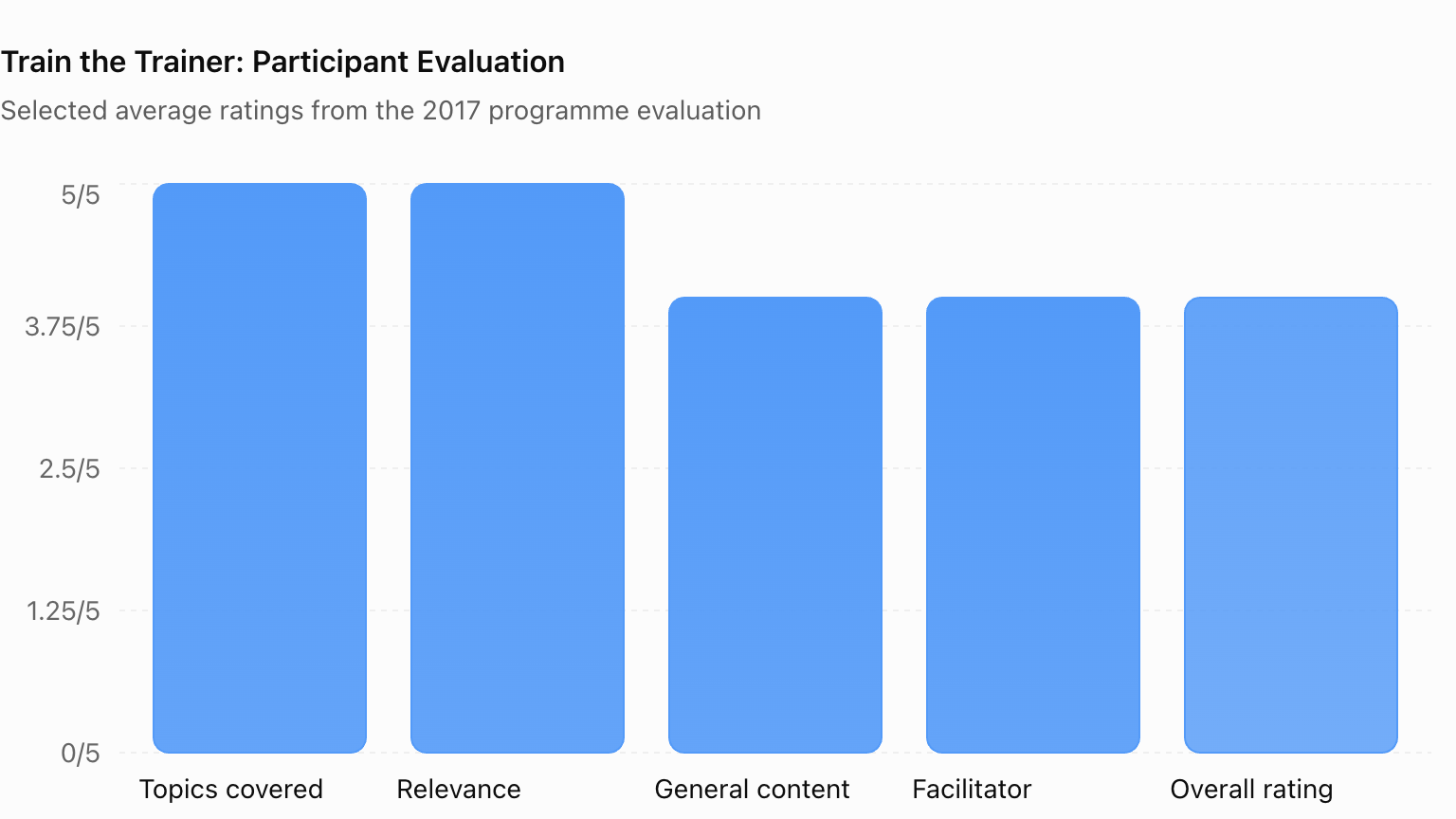
Participant Evaluation: Train the Trainer Programme (2017)
Selected average participant ratings from the programme evaluation, measured on a five-point scale.
Source: Joy Prime, Train the Trainer Programme Evaluation Report, August 2017.
6. Professional Contribution
The Train the Trainer programme demonstrates Joy Prime's expertise in curriculum design, adult education, workplace learning and organisational capacity building.
Joy was responsible for designing the six-module training curriculum, facilitating the workshops and evaluating programme effectiveness. The supporting learning resources were developed in collaboration with colleague Angela Ishmael.
The programme connected adult learning principles with the practical needs of small enterprises, enabling participants to identify workplace skills gaps, develop structured learning pathways and begin preparing company training manuals.
The assignment demonstrates Joy's ability to lead curriculum development, collaborate with other education professionals and manage programme delivery, assessment and evaluation.
It also illustrates her experience in developing practical workforce training solutions tailored to the operational circumstances of small businesses.